
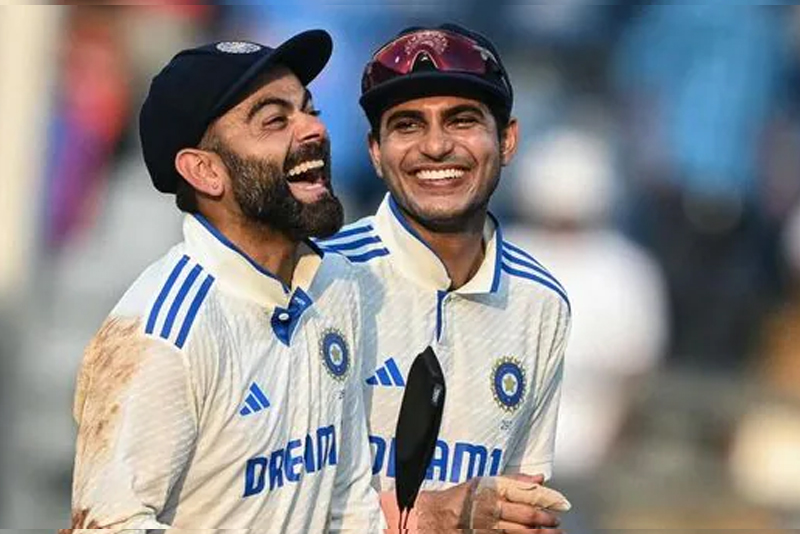

How Fair Is It to Compare Shubman Gill with Virat Kohli on the England Tour?
June 9, 2025
Kathmandu- Comparing cricketer Shubman Gill with Virat Kohli at this moment may not be entirely appropriate. However, if we draw parallels with the situation in 2014, when Virat Kohli was handed the Test captaincy following Mahendra Singh Dhoni’s sudden retirement from Test cricket, the context looks slightly different.
In 2014, when Kohli took over the Test captaincy, he had already played 29 Test matches and scored 1,855 runs. During that period, he had hit 6 centuries and 9 half-centuries. Kohli’s batting average stood at 39.46, and he was only 26 years old at the time.
Now, when Shubman Gill steps out for the toss at Headingley on June 20 as India’s captain, he will be 25 years and 285 days old. In terms of age, Gill will become the fifth-youngest Indian Test captain after Tiger Pataudi, Sachin Tendulkar, Kapil Dev, and Ravi Shastri (who captained just one Test).
So far, Gill has played 32 Test matches and scored 1,893 runs, which includes 5 centuries and 7 half-centuries. His current Test average stands at 35.05.
Since 2011, Virat Kohli has established his dominance in One Day Internationals, but it was his Test captaincy that truly laid the foundation for his greatness. Kohli went on to become India’s most successful Test captain, a journey that Shubman Gill has witnessed firsthand.
Gill understands that if he wants to become a successful Indian captain, the first and foremost requirement is to overcome the challenges of Test cricket.
Shubman has time on his side, as he is still young — just as Kohli was in 2014.
For now, Gill has been appointed captain only for the England tour, but selection committee chairman Ajit Agarkar has stated, “We don’t appoint a captain for just one or two series. We want to invest in someone who will benefit us in the long run.”
The England tour also marks the beginning of the new World Test Championship cycle, which will run for two years.
In many ways, Gill has been thrown into the deep end — and now it remains to be seen whether he can swim.
Not every captain is the same. Gill’s temperament doesn’t quite match Kohli’s aggression or Rohit Sharma’s calmness. However, he does seem to carry a mix of both traits.
Shubman Gill is a player who works with the calm composure of Rohit Sharma and the self-awareness of Virat Kohli.
At a time when India’s Test team is undergoing transition, the selectors have not only recognized Gill’s batting talent, but more importantly, they have seen a sense of “stability” in his personality — something they clearly value moving forward.
Although it may not be fair to compare success in T20 cricket with Test cricket, the T20 format does require a captain to respond to every ball, offering insights into how well a player performs under pressure.
This was Shubman Gill’s second IPL season as captain of Gujarat Titans. Unlike players such as KL Rahul, Sanju Samson, and Rishabh Pant — whose batting has often been negatively affected by captaincy — Gill proved to be an exception.
This year, Gill not only maintained control over his team (Gujarat Titans) but also showed remarkable composure and maturity in both victory and defeat.
Now, Gill faces his real test in the toughest format of the game — Test cricket.
In the recent Border-Gavaskar series, Gill played only three out of five Tests. When Rohit Sharma decided to sit out the final Test in Sydney, Gill was brought back into the playing XI.
However, he was dismissed early in both innings of that Test. In the first innings, he fell to Nathan Lyon’s spin just before lunch, and in the second, he was taken out by medium-pacer Beau Webster.
Appointing Gill as Test captain just four months after that performance is no ordinary decision — it has the potential not only to change the trajectory of his career but also to shift the course of Indian cricket itself.
Former India captain Anil Kumble has said that before Shubman Gill can cement his place as a captain, he must first establish himself as a successful batsman. Despite recent injuries, Kumble believes that Gill will need at least ten Test innings to settle in as a captain.
Gill is well aware that his record in England has been disappointing so far. In the six innings he has played there, he has scored only 88 runs at an average of 14.66.
In contrast, KL Rahul has scored 614 runs in 18 innings in England at an average of 34.11, including one century and one half-century. Vice-captain Rishabh Pant has also performed better, scoring 511 runs in 15 innings at an average of 34.06, with two centuries and two half-centuries to his name.
Apart from these two, no other Indian batsman has significant experience or notable success in England, which is why Indian cricket fans are understandably concerned.
Gill has had the opportunity to observe leadership and decision-making closely during series against Bangladesh, New Zealand, and Australia. He understands that in cricket, a phase of change always follows failure.
First, the captain goes, then the coach. India has lost its last two Test series. Following those defeats, there was a change in captaincy, and now questions are being raised about head coach Gautam Gambhir’s role as well.
In this context, Shubman Gill has a golden opportunity to prove himself as a leader. If he demonstrates good decision-making and consistent performance, he has the potential to become the long-term captain of India’s Test cricket team.
2025 @ CricketKitchen Architect with SoftCrunch